
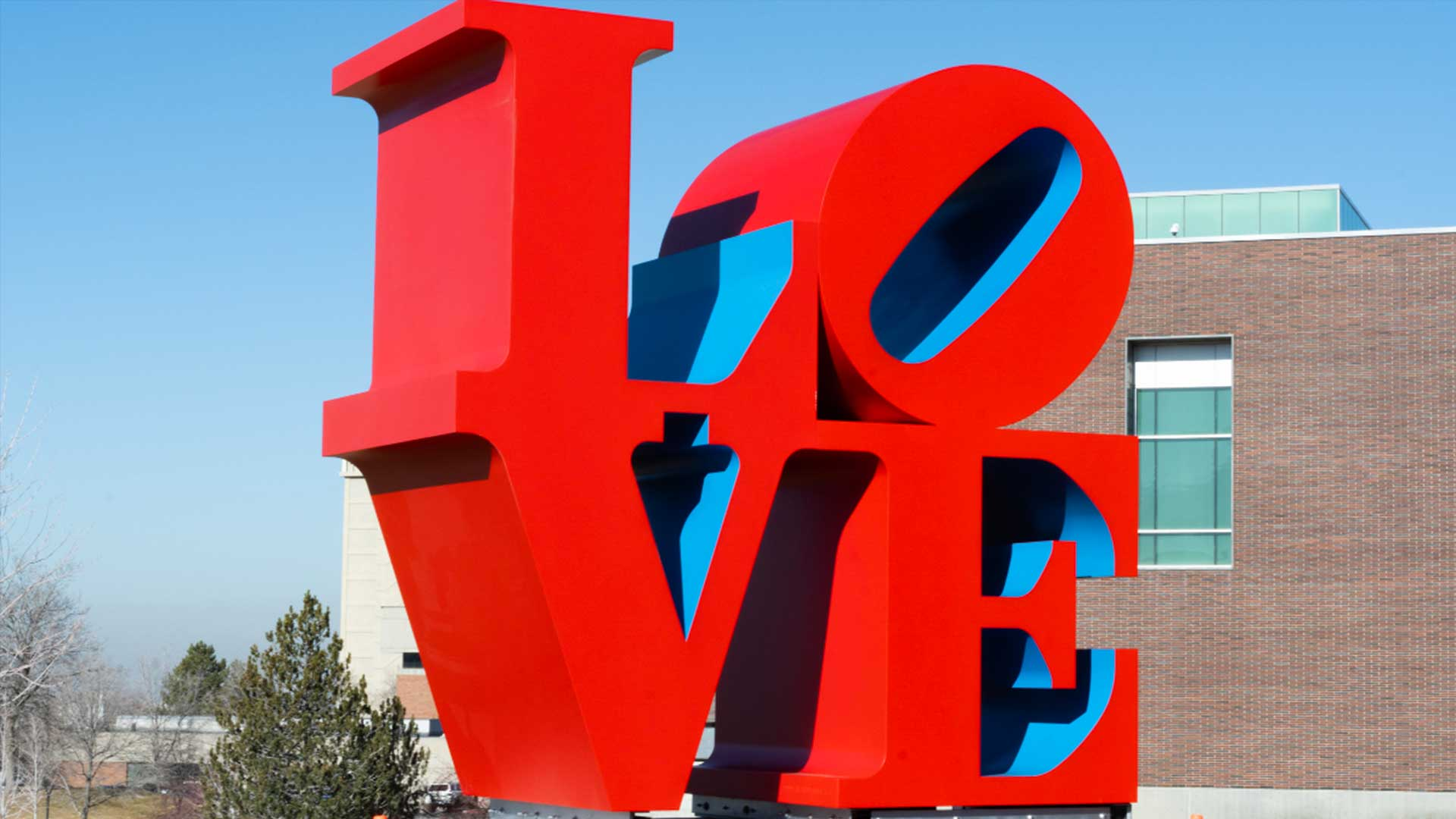

When we think of “Love,” we usually think of hearts, flowers, and fragile emotions. We think of it as soft.
Last week I was driving past the Utah Museum of Fine Arts, and caught a glimpse of the newly installed Robert Indiana LOVE sculpture. That sculpture isn’t delicate. It is made of Cor-Ten steel. It weighs hundreds of pounds. It is industrial. It weathers the elements, it rusts, but it stands firm.
It was a visual reminder of a truth I’ve been thinking about a lot lately: Love is structural.
In business, we tend to treat connection and empathy as “nice-to-haves”—decorations we put on top of the real strategy. But in 2026, I am convinced that Love is the steel that holds everything else together.

The Survival Imperative
History tells us that love isn’t just an emotion; it’s a survival mechanism.
Ancient Spartan tactics relied on the Phalanx—a formation where every soldier’s shield protected the man to his left. A soldier didn’t just fight for himself; he fought to keep the line unbroken for his neighbor. The system only worked if you trusted your life to the person standing next to you.
This isn’t ancient history; it is modern doctrine. The U.S. Military codified this into a system of strategic partnership. In the Army, it is a “Battle Buddy.” In the Air Force, a “Wingman.” In the Navy, a “Shipmate.” Different branches, same rule: You are never to be alone.
In Basic Training, recruits are taught a simple doctrine:
- You are never to be alone.
- You watch your partner’s back.
- You are responsible for their safety and their mindset.
It forces a shift from “me” to “we.” Commanders know that under extreme stress, you might give up on yourself, but you won’t give up on the person counting on you.
It is why I advocate so strongly for building a “Personal Board of Directors.” Whether it’s a mentor, a “work spouse,” or a trusted peer, we are wired to survive and thrive when we are paired.

The Most Powerful Thing AI Can’t Replicate
As many of you know, I am bullish on AI. I use it every single day.
I spent a semester of graduate work at Johns Hopkins focusing on Human-Computer Interaction (HCI) and online trolling, and the research I did there stuck with me: We treat entities differently when they don’t have a face.
We treat people differently when we are not face-to-face. When we lose the voice, the treatment degrades further. And when we know the entity isn’t “human,” our behavior becomes unpredictable.
Science shows that while we can simulate conversation, we cannot simulate care.
In 2026, AI can write your code, optimize your marketing funnel, and generate your strategy. But let’s be clear about what is actually happening behind the curtain. It is, at its core, a complex mathematical prediction engine.
It does not think. It does not feel. The “reasoning” you see is often an illusion by design—some interfaces even artificially slow down responses to make the machine appear more thoughtful than it actually is. It is processing, not pondering. And despite the hype, this current architecture is simply executing a program.
And a program cannot give a damn about your customer.
To be clear, automation is a good thing. It solves problems and helps people at scale. But here is the economic reality of 2026: When AI makes “average” work abundant and cheap, Care becomes the new scarcity.
If love isn’t an ingredient in your business strategy—if you don’t genuinely care about your employees and partners—you aren’t building a brand. You are building a commodity.
You are entering a race to the bottom where the only differentiators are scale and cost control. That is a game AI will always win. The only way to change the game is to offer the premium asset the machine cannot: Care.
But what does ‘Care’ actually look like on a balance sheet? Let me show you.

Operationalizing Empathy: The Chewy Case Study
I want to give you a concrete example of what “Structural Love” looks like in a P&L.
Consider Chewy. To a standard algorithm or a basic CRM, a customer cancelling a subscription because their dog died is just a churn metric. It is a revenue leak.
But Chewy treats it as a human moment.
When a customer contacts them about a passed pet, they don’t just process the cancellation. They refund the order. They tell the owner to donate the food to a local shelter rather than worrying about a return.
And then they do the thing that doesn’t scale: They send flowers and a handwritten sympathy card.
This isn’t a glitch; it is a strategy executed by their “Wow Team.” As their Chief Customer Care Officer Shiv Menon notes, customers “talk about how we made them feel, not just about the problems we helped solve.”
In sales terms: The passing of a pet is an expected step in the customer lifecycle. By meeting that tragedy with love rather than bureaucracy, they forge a connection so deep that when that customer eventually welcomes a new pet, there is only one brand they will turn to.
An AI agent can process a refund. But it cannot empathize with your loss, or make you feel truly seen and understood.

The Physics of Connection
I want to share a photo that means a lot to me.

This past summer, my friend Emily was in Paris and put this lock on the Pont des Arts—the famous “love lock” bridge where couples from around the world attach padlocks to the railing to symbolize their commitment. She added a lock with the initials K + L for Kody and Lonny.
When Emily sent me this photo, I thought of two things immediately. One was a quote from an instagram reel I had been seeing a lot recently (the grief algorithm is a thing)
“Our time together is limited, our love is not.”
The second was a line from the movie Interstellar. While it is a science fiction film, the character Dr. Brand posits a theory that feels like absolute truth to anyone who has grieved:
“Love is the one thing we’re capable of perceiving that transcends dimensions of time and space.”
My work in the healthcare space has taught me that this is backed by hard data, too. The Harvard Study of Adult Development—the longest study on human happiness—found that the quality of your relationships is the single strongest determinant of your health and lifespan. Not your cholesterol, not your bank account. Your connections.
Open your heart to the world. If not for your business, do it for yourself. It is the only way to live a healthy, fulfilling life.

Feeding the Right Wolf
So, if love is a competitive advantage, a survival mechanism, and a health requirement… why is it so hard to lead with it?
Because we are in a constant battle.
There is an old Cherokee parable where a grandfather teaches his grandson about life. “A fight is going on inside me,” he tells the boy. “It is a terrible fight and it is between two wolves.”
One is Evil: It is anger, envy, greed, and arrogance. In our world, this is the wolf that drives “churn and burn” cultures and leads by fear. It prioritizes the quarterly return over the human being.
The other is Good: It is joy, peace, humility, and love. This is the wolf that builds loyalty, retention, and sustainable growth.
He tells the boy, “The same fight is going on inside you—and inside every other person, too.”
The grandson thinks about it for a minute and then asks, “Which wolf will win?”
The grandfather simply replies, “The one you feed.”
Every day, we choose which wolf to feed. We feed the evil wolf when we choose control over trust. We feed the good wolf when we choose empathy over efficiency.
We saw this truth flashed on a giant billboard at the Super Bowl Halftime show produced by Bad Bunny: “The only thing that is more powerful than hate is love.”

You don’t beat hate with more hate. And you don’t beat burnout with more grinding. You beat it by feeding the other wolf. Two of my idols understand this deeply, and they are still fighting the good fight.
- Arnold Schwarzenegger (78) feeds the good wolf through service. For decades, he has spent Thanksgiving at the Hollenbeck Center handing out turkeys—not writing a check from a distance, but showing up to serve food and connect with people face-to-face. He continues to champion the Special Olympics and shares his messages of mindset and motivation freely. (If you haven’t tuned into his podcast, Arnold’s Pump Club, I highly recommend it. It is about A LOT more than just fitness and health.)
- Dolly Parton (80) embodies the true spirit of “loving thy neighbor.” She is a symbol of acceptance who spreads love by empowering others. In fact, estimates suggest Dolly would likely be a billionaire today if she hadn’t donated over $500 million to causes ranging from the Imagination Library to the research that helped create the Moderna COVID-19 vaccine. She literally gave away her billionaire status to help others. As she wrote in her most famous song: “I wish you joy and happiness. But above all this, I wish you love.”

The Takeaway
If this past year has reaffirmed and strengthened any of my beliefs, it is in the power of love. I believe this because I’ve seen the alternative. We know what happens when you don’t lead with love. I covered that in ‘Lessons from the Dark Side.‘ Structures built on fear are fragile. They eventually collapse
Love is the only material strong enough to build a legacy on. It is the Cor-Ten steel of your strategy. It isn’t soft; it is structural. And in 2026, it is your greatest competitive advantage.
But remember, you cannot pour from an empty cup. As researcher Brené Brown writes in Atlas of the Heart, “We can love others only as much as we love ourselves.”
If you are struggling to feed the good wolf, start with yourself. You can’t build a culture of care if you are running on fumes.
If you need a place to start, I encourage you to take the Self-Compassion Test by Dr. Kristen Neff. It’s one of many free resources on Dr. Neff’s website I found helpful during my own burnout recovery.
I wish you joy, but above all, I wish you love.
See you next month, Seth
A Note on Process: In the spirit of full disclosure, I partnered with an AI thought partner to help organize my scattered thoughts on Greek history, grief, and business strategy into this cohesive newsletter. But the stories, the scars, and the love are 100% mine.
I share this because these tools aren’t magic; they’re a discipline. You can’t just watch from the sidelines. You have to actually try this stuff and play around with it to get good. As Arnold would say, “You got to put in the reps.” Go put in yours.


